BOOK REVIEW Co-Existence: The Next Phase of AI

About the author

Richard Bailey Hon FCIPR is an assessor with PR Academy. He has taught and assessed undergraduate, postgraduate and professional students.

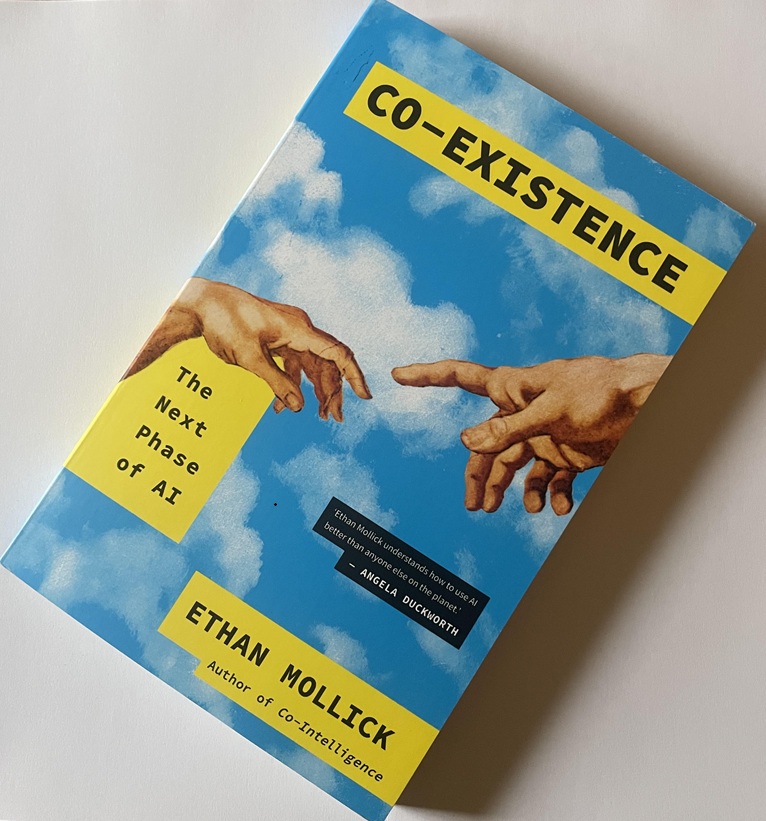
Co-Existence: The Next Phase of AI

Ethan Mollick

WH Allen, 2026, 220 pages

In his previous book Co-Intelligence Ethan Mollick described artificial intelligence as an ‘alien mind’. He provided a framework for humans to harness its abilities.

Read the review of Co-Intelligence

This new book, written three years on, opens with a warning. ‘Soon, if not today, AI is going to be better than you at some of the things that matter to you.’ So the book is ‘about how to co-exist with an AI that is sometimes, but not always, better than you.’

With over a billion people using AI weekly, it’s now clear that we’re witnessing the fastest technology adoption in history. ‘It took the telephone 75 years to reach 100 million users, Facebook four and a half years, and ChatGPT just two months.’

Here at PR Academy, we receive scores of AI declarations accompanying CIPR professional assignments. These suggest that most communication professionals already have a sophisticated understanding of the many ways AI can support their work, short of (in most cases) actually writing it. It’s rare to find a statement that confidently declares no use of AI whatsoever – because how can you be sure that AI was not used in your online searches or in your grammar and spell checking?

We now know the uses people are making of AI since OpenAI released data on how people are using ChatGPT in September 2025. ‘Nearly 80 per cent of all conversations fall into just three categories: practical guidance (tutoring, how-to advice, personalized recommendations), seeking information (the AI version of Google) and writing (drafting, editing, translating).’

That surely explains the moral panic around AI use and abuse in education. Yet Mollick is phlegmatic: ‘the cheaters are ultimately cheating themselves.’


Other concerns are over AI’s profligate use of resources. Here, Mollick has some reassuring statistics. He estimates that by 2030 ‘all US data centers would use around half as much water as is spent irrigating golf courses every day in the US, yet those data centers generate roughly fifty times more tax revenue than a golf course per unit of water.’

And on the electricity used to answer a query: ‘the marginal energy consumed by a standard prompt from a modern LLM is roughly 0.0003 kWh. That’s equivalent to eight to ten seconds of streaming Netflix, or about what a Google search used in 2009.’

Yet because of the scale of its use, ‘AI could account for 3 to 4 per cent of global energy consumption by 2030, up from less than 1 per cent today.’

A key central chapter in this book (4: How to Work with AI) contrasts the painstaking step-by-step series of prompts needed at the time of the previous book with the much more powerful AI models and agents available today. He also acknowledges where his previous advice was outdated, such as the recommendation to instruct AI to act as an expert, or as a journalist or another persona.

Where we once talked about prompt engineering, Mollick now talks about context engineering. ‘Increasingly, the skills that matter when working with AI now aren’t technical skills. They’re management skills.’

‘A core element of management is providing the structure people need to get their job done. And context engineering is the same thing.’

Mollick goes on to describe the difference between a Large Language Model (LLM) and an AI agent in language that sounds like the distinction between an output (eg a memo) and an outcome (eg adoption of a companywide AI policy).

He describes the manager’s role when working with AI agents as that of a conjuror. ‘In conjuror work, you define the task, assign it and evaluate the output. You are not in the loop when the task is being done…. In short, you must clearly delegate work to the AI.’

We have moved from a world of prompt engineering to a world of delegation.

Yet ‘every time you hand something to an AI, you’re making a trade. In return for speed and quality, you might give up practice, learning, and the slow thinking required for your very human ideas.’ That’s why educators and trainers warn students not to rely on AI outputs. They might pass the assignment, but fail to learn from the course.

So, when should we refuse to work with an AI? Mollick devotes a chapter to exploring ‘the human advantage.’

Because while one risk is AIs becoming smarter and replacing us, the other is AI use making us dumber.

A 2025 study found that students who used ChatGPT to write essays were less engaged and remembered less about their work.

There’s a distinction between those measurable tasks where an AI can learn to achieve results (like winning at chess), and those where there is no clear outcome. Here it’s the process that’s important, and that’s where humans can retain their edge.

Developing a PR plan is an example of this. A plan is not an outcome but rather a step towards achieving an outcome. Yet the process of developing the plan ensures debate, exposes divisions, reveals constraints and hopefully leads to agreement. The process is the product.

The author is not a technologist; he studies entrepreneurship. That’s why his section on organisations is so insightful. In summary, while AI is currently speeding up processes, humans are slowing them down and creating bottlenecks.

This raises the nightmare vision of everyone except the bosses of AI companies: that organisations would function more smoothly without the pesky people.

Sign up to our newsletter to hear about future book reviews

Yet it’s not so simple nor so straightforward. Jobs are a complex bundle of different tasks. Looking back on the history of technology adoption, Mollick asserts: ‘when a new technology arrives, it does not replace the job. It replaces some tasks within the bundle… That is what happened to accountants when spreadsheets arrived, and to designers when desktop publishing arrived, and to everyone when email arrived.’

And yet there are signs that something different is happening this time, starting with the reduction in entry level jobs. ‘If those entry level jobs disappear, the pipeline that creates experienced workers shuts off.’

There’s one prediction that can be made with certainty: ‘transformative technologies create change.’

For individuals, there’s a moment of opportunity as well as the looming threat to our jobs.

‘Done right, [AI] expands your capabilities and makes you more creative than you were before. Done wrong, it atrophies the very skills that matter most.’