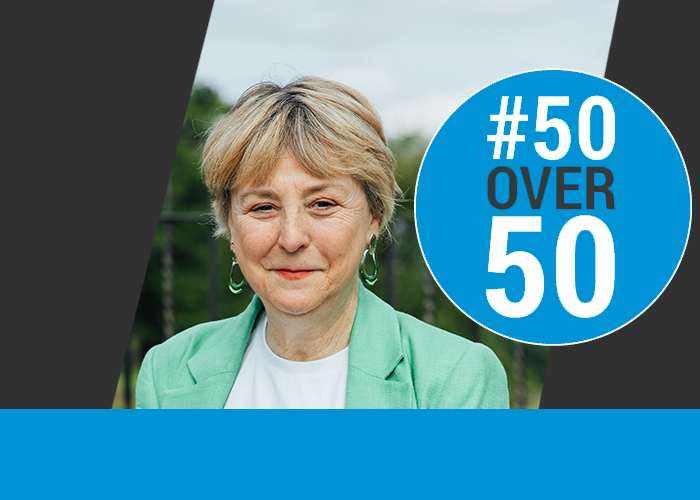
#50over50: Rosie Hamilton

About the author

Ann is a co-founder of PR Academy. Her special areas of interest are internal communication, change management and project communication. MSc, Dip CAM, Hon FCIPR

For the latest in our occasional #50Over50 series, I speak to Rosie Hamilton, founder of Bees Knees Marketing.

Rosie, who describes herself as a “senior player” (I like that!) studied for the CIPR Professional PR Diploma with us at PR Academy. She provides strategic marketing and PR services to small businesses and is the Volunteer Social Media Manager for the CIPR Crisis Communication Network’s Committee.

You know when you’ve found the right job because suddenly you aren’t bored anymore!

When Rosie Hamilton took on a maternity cover post as head of marketing in further education she knew she had found her “home”.

Prior to this, after flunking her A Levels (Rosie’s words!) she set off travelling and lived in New Zealand before returning to London to do various office jobs. It was all good experience but not fulfilling. So at the age of 33 she decided to have another go at education. This led to a BA Honours in art, architecture and design history.

Rosie picks up the story. “After graduating I wasn’t sure what to do and was working part time at an adult college. I knew that I didn’t want to teach. The principal was an amazing woman and one day she told me that the marketing manager was going on maternity leave and why didn’t I cover the role while I decided what to do?”

I think its fair to say that Rosie didn’t look back!

We achieved so much as a team. Project managing and designing a 140-page prospectus, campaigning for funding with our local MP, launching a business school and even doing a case study on Tom Hardy who was an alumni at the drama school.

Rosie says that she was learning on the hoof: “I didn’t have any training, but I think my people skills really helped. I think this is one of my strengths alongside understanding how teams work and getting the best from team members who can all be so different.

Her next role gave her an introduction to crises and sparked an interest that has continued. Alongside her consultancy work, Rosie is the social media manager for the CIPR Crisis Communication Network.

From the FE college, Rosie moved to the Chartered Governance Institute – the qualifying body for company secretaries.  It was the time of the financial crash in 2008.

As the crash happened, corporate governance became a hot topic. It was a crisis for financial institutions and others but it was also an opportunity for the Institute and Rosie.

Working alongside the policy department, Rosie was obtaining national media coverage on the value of good governance. The institute’s policy director led a consultation process on boardroom behaviours and the findings were then included in the Walker Report, a significant government sponsored review of UK corporate governance. “It gave us a voice” says Rosie.

For younger readers, the financial crash of 2008 is perhaps a classic example of how a crisis can develop – all the signs were there; the issues were bubbling under before it became a full-blown crisis.

It was a major worldwide financial crisis that started in the United States. The causes included excessive speculation on property values by both homeowners and lenders.

Rosie recalls:

I remember being out shopping with my neighbour and seeing a massive queue outside the bank Northern Rock – we wondered what on earth was going on.  People were queuing to get their money out!

But it was a personal near-crisis experience that caused Rosie to think about life and work in a new way.

While on a camping trip with friends she narrowly missed being crushed by falling trees – she was saved thanks to her new puppy who had distracted her away from the danger.

Rosie had recently relocated and despite having had senior roles she had never had any formal training.

It was time to change things up!

Rosie says: “Things have moved on so much – when I started work we were sending things by telex and fax.  Mobile phones weren’t around until I was in my 30s. Social media didn’t even exist!

“Where do you look for inspiration? If you think about it, how many mature female business influencers do we have? Apart from Deborah Meaden?”

So Rosie embarked on the CIPR Professional PR Diploma.

It was really good to be challenged. I think it’s given me so much confidence, imposter syndrome can creep in especially as you get older and you can seem invisible at this age.
As “senior players”, Rosie and I agreed that having maturity in the team matters, particularly from a business perspective, otherwise the mature stakeholder/customer groups can get missed or aren’t understood.

Rosie explains: “Recently someone was doing a B2C campaign and had completely missed out the older market in terms of their demographics and couldn’t really explain why.”

Its an opportunity missed when the older generation are often the ones with money to spend.

For the past eight years Rosie has been working freelance, specialising in supporting small businesses.

It’s clear she loves the work which is exceptionally varied. She also works collaboratively with a number of creative partners such as graphic designers, SEO, branding and video specialists to provide a comprehensive PR and marketing offer.

Finally I ask Rosie what her advice would be to a young person wishing to enter the PR job market at the moment.

“I would start by asking around to see if anyone you know has any connections in the industry. Ask everybody – even your mum and dad’s friends how they might be able to help you.

“I’ve learnt this recently because I relocated. You have to put yourself out there and build connections. I tracked down all the people that I would like to work with on social media, followed them and engaged with them. I actually found a role this way before I decided to go freelance.”

However, it works the other way round too. Us senior players have a responsibility to help the younger generation when they do reach out she says. “At the recent excellent CIPR Midlands Conference a student approached Rod Cartwright one of my fellow Crisis Communications Committee members asking for advice on her dissertation. While Rod couldn’t help he was able to put her in touch with someone who could.”

So when a young practitioner needs help, lets remember that was us once!