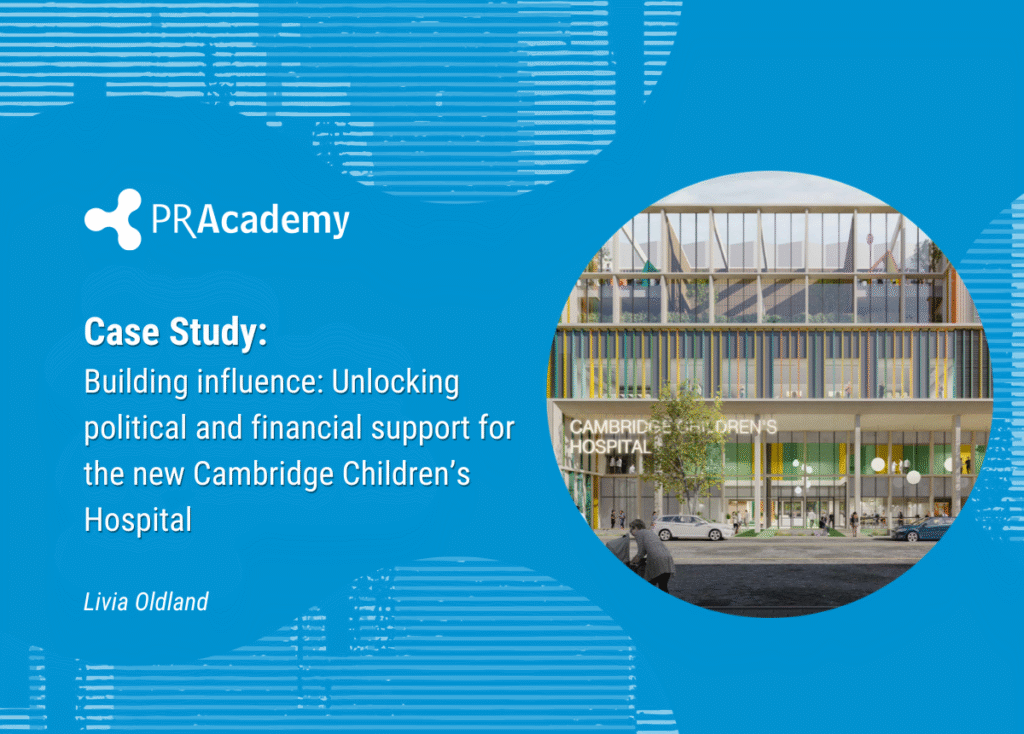
Building influence: Unlocking political and financial support for the new Cambridge Children’s Hospital
About the author
Livia developed a campaign for the Cambridge Children's Hospital for her CIPR Professional PR Diploma Unit 1 assignment. It has been edited into a case study for publication.
The East of England is currently the only region without a specialist children’s hospital, resulting in children and their families needing to travel hundreds of miles to receive treatment. Furthermore, existing services for mental and physical health can be fractured, with children facing long wait times.
The NHS survey of Mental Health of Young People in England 2023 showed that one in five children have a probable mental health disorder, a large increase from 2017 of one in eight children. The Children’s Commissioner for England recently published research showing that children waited an average of six months for mental health treatment, and a third waited over a year to receive support.
Cambridge Children’s Hospital (CCH) is a planned new specialist facility for children and young people across the East of England. The holistic approach of treating mental and physical healthcare together will be a world-first, along with a globally recognised research centre.
The challenge
The need for a new children’s hospital for the East of England was first identified in 2004 by Cambridge University Hospitals NHS Foundation Trust, with the first Strategic Outline Case (SOC) completed in 2005. Twenty years and seven iterations of the SOC later, the Project Team now plan to submit their Full Business Case in 2026 to the Government, ahead of construction starting in 2027.
The project is now at a critical stage and closer than ever into turning the plans into reality. In addition to government and NHS funding, the new hospital requires £100 million of private funding raised through philanthropy, and while the halfway mark was reached in December 2023, there is still a significant amount of money to be raised.
Furthermore, the NHS is undergoing a rapid period of change. There have been wide-ranging reforms, including abolishing NHS England and thousands of job losses. Funding for many NHS infrastructure projects are currently on a knife-edge, with 18 of the 40 new hospitals planned as part of the New Hospital Programme delayed until after 2030.
However, there is great support for delivering a new model of care for the NHS, with the Government launching its 10 Year Health Plan in 2025. CCH vision of care closer to home, harnessing research innovations and using digital technology naturally aligns with the Plan’s ‘3 radical shifts’.
Relationships with UK politicians
CCH has received limited discussion in Parliament with only five mentions since 2019. However, there are over 30,000 instances of the NHS in Hansard. Perhaps it is unusual for such a large infrastructure project to receive limited discussion, but the Government’s New Hospital Programme has only 251 mentions.
Cambridge University Hospital – one of the main partners of CCH – has a comprehensive public affairs programme. Previously over 30 MPs pledged support for CCH back in 2022 after it was spearheaded by former South Cambridgeshire MP, Anthony Browne. The current incumbent, Pippa Heylings MP, has recently said she wants to get CCH “over the line”. Kemi Badenoch MP, the current leader of the Opposition, visited the CCH site in September 2025, alongside the Cambridgeshire and Peterborough Mayor, Paul Bristow. They reiterated their support for the new hospital.
While CCH has generally benefited from positive political engagement, a dynamic geopolitical environment may mean that the Government’s attention is diverted abroad.
Furthermore, with government approval ratings at just 12%, it is essential to garner support from a range of political parties in case of snap elections and leadership changes.
National trends towards charitable giving
The Charities Aid Foundation 2025 UK Giving Report presents bleak reading on the nation’s appetite for charitable giving. While the UK public donated an estimated £15.4 billion in 2025, the percentage of the public donating has fallen from 58% in 2019 to 50% in 2024, a decrease of around £4m.
The largest decline in donations came from young people, with donations down a third since 2017.
The Charities Aid Foundation (CAF) report provides several recommendations on how to increase donations, including using storytelling to build trust and reputation, explaining the impact, as well as looking at opportunities to engage young people.
Support Cambridgeshire in their 2023 report mirror the data from the Charities Aid Foundation, showing a decrease of real-time charitable income in the county equating to around 12% from 2018. However, Addenbrooke’s Charitable Trust (a philanthropic partners for CCH) is listed in the top ten Cambridgeshire charities.
The CCH charitable partners are currently preparing to launch a fundraising campaign. It is essential that the communications team take on board the recommendations from CAF on explaining the importance and impact of donations, as well as engaging young people.
Public opinion towards infrastructure projects
The Institution of Civil Engineers (ICE) recently published research on public opinion towards public infrastructure projects.
The polling found that the majority of the public think infrastructure projects are poorly communicated (62%), with people wanting to know the reasons and benefits for the infrastructure (47%), transparency on funding (38%) and the financial impact on the tax payer. The ICE reiterated that communications for infrastructure projects need to clearly articulates the benefits, it’s necessity, with transparent information on funding.
Celebrities and politicians: a symbiotic or parasitic relationship?
A 2018 YouGov poll reported that the “Majority of Britons want celebrities to keep their political opinions to themselves”, with 52% of those surveyed having a negative view of celebrities involved in politics. However, there are numerous examples of celebrities successfully lobbying elected representatives in healthcare, including the late broadcaster Dame Deborah James successfully changing the NHS bowel cancer screening age from 60 to 50 in 2025.
The footballer Marcus Rashford in 2020 campaigned for free school meals in the school holidays. His lobbying led the Government to reverse their previous decision, even if the Minister at the time refused to acknowledge his impact.
Whether the public or our elected representatives like it or not, celebrity involvement in political discourse can influence policy leading to societal change.
Celebrities spearheading NHS infrastructure projects
Celebrities have a long history of campaigning for medical infrastructure in the UK, sometimes on behalf of the NHS, and sometimes in opposition. A range of celebrities are currently campaigning against the rumoured closure of Goole and District Hospital in Lincolnshire. Alder Hey Children’s Hospital successfully launched a £30million new campaign in 2013 to fund a new building, with support from a range of celebrities.
The opportunity of influencer marketing?
CIPR defines influencer marketing as: “partnering with individuals who have a significant audience and influence within a particular segment. They argue that influencer marketing is no fad – an estimated £11.5 billion was spent on influencer marketing alone in 2022.
CCH lists several influencers on their ‘What people are saying’ webpage. It includes comedian Sir Stephen Fry, Children’s Commissioner for England, Dame Rachel de Souza, and broadcaster Dr Xand van Tulleken.
There is a real opportunity at this critical time before submitting the Full Business Case to further develop relationships with celebrities to garner political and fundraising support.
Communication campaign recommendations
AMEC 2025 Barcelona Principles V4.0 state that “setting clear, measurable objectives is a critical prerequisite for effective communication planning, measurement and evaluation”. The following objectives align with their guidance, as well as the Government Communications Service OASIS model on objective setting. AMEC recommend that objectives are not just SMART, but SMARTER with continuous evaluation, so it is recommended that the below objectives are reviewed at quarterly points across the twelve-month period.
These objectives aim to obtain political and government support for the new hospital, along with raising vital funds.
- Awareness objective: Inform at least 50 key political stakeholders and 100 prospective donors on the benefits and funding model of CCH, including the construction timeline, by the end of 2026.
- Awareness objective: Increase understanding of research in paediatric medicine currently carried out at Cambridge Biomedical Campus and how CCH will be a world-exemplar in child health by at least 10% of identified stakeholders by mid-2026.
- Attitudes objective: Promote engagement with children and young people for CCH to at least 100 younger prospective donors (18-24 year olds) by end of 2026, increasing awareness of co-production in the development of the new hospital.
- Behaviour objective: Target 20 high-profile influencers and build relationships, resulting in at least five new celebrity champions to provide advocacy for CCH by the end of 2026.
- Behaviour objective: Obtain a public pledge of support signed by at least 10 elected representatives for CCH by Autumn 2026.
Additional task/process recommendations
- Further research into potential celebrity champions, including health influencers.
- Development of a stakeholder engagement plan for political and celebrity stakeholders.
- New messaging on the benefits, timeline and funding model.
- Drafting of a media plan focused on research and engagement with young people.
Background research
Finland’s New Children’s Hospital
Finland opened Helsinki’s New Children’s Hospital (NCH) in 2018 and an astounding one million Finnish residents (or 1/5th of the population) gave €40 million towards the total €170 million build for the new hospital. While the fundraising for the hospital wasn’t without its controversies, the funding model mix of public and private capital raised through philanthropy is similar to CCH.
Alava, Lindroos and Pihlman analysed the campaign for Finland’s NCH. The campaign started in February 2013 with the aim of raising €30 million and reached its target in just 18 months. The multichannel campaign used traditional techniques including TV and print advertising, as well as a ‘Live Aid’ style song by famous pop stars. The campaign benefitted from high-profile political supporters, such as the former president of Finland. The campaign’s original head of fundraising later became the Finnish Minister of Transport and Communications.
Their analysis of the narrative shows the story arc of the campaign, starting with the need for public philanthropy for state healthcare, followed by the urgent requirement of the facility, and finally ending with NCH acting as a beacon for Finnish technological advances and world-class healthcare.
The core arguments of the NCH campaign have many parallels with the current messaging for CCH; ‘Whole New Way’ of caring for children and young people to alleviate suffering, and build upon discovery science and research from Cambridge.
Stakeholder mapping of Cambridge Children’s Hospital
Mitchell, Agle and Wood stakeholder mapping system is based on salience, “as a way of understanding which stakeholders do really count”. They group stakeholders by their power, legitimacy and urgency and using a Venn diagram representation, they are then broken down into eight stakeholder categories. The stakeholders with the most ‘salience’ or importance are those that have all three attributes, and are referred to as ‘definitive’ stakeholders.
Unsurprisingly, organisations will want to naturally put resources into managing stakeholders categorised as “definitive”. Stakeholders described as ‘dangerous’ have power and urgency, but little legitimacy, and it would be a mistake to simply ignore this group. While they do have inherent risk, there could be opportunity, especially in engaging certain celebrities and influencers (and therefore providing legitimacy).
| Name | Power | Legitimacy | Urgency | Group |
| Secretary of State for Health and Social Care | 9 | 9 | 9 | Definitive |
| Regional MPs | 7 | 7 | 9 | Definitive |
| Local councillors | 4 | 6 | 8 | Dependent |
| Healthwatch | 6 | 4 | 4 | Dormant |
| University of Cambridge | 9 | 9 | 9 | Definitive |
| Cambridge University Hospitals NHS Foundation Trust | 9 | 9 | 9 | Definitive |
| Cambridgeshire and Peterborough NHS Foundation Trust | 9 | 9 | 9 | Definitive |
| Building contractor (Bouygues UK) | 4 | 7 | 7 | Dependent |
| Regional NHS commissioners | 6 | 7 | 5 | Dominant |
| Patient Advisory Board | 6 | 8 | 3 | Dominant |
| Current hospital staff | 3 | 6 | 3 | Discretionary |
| Philanthropic partners* | 5 | 7 | 8 | Dependent |
| Celebrities and influencers | 6 | 3 | 8 | Dangerous |
| National media | 6 | 1 | 8 | Demanding |
| Regional media | 3 | 1 | 7 | Demanding |
| Third sector partners | 3 | 3 | 7 | Demanding |
| Children and families from the region | 3 | 8 | 3 | Discretionary |
PESTLE Analysis
| Political | Economic | Sociological |
| The NHS 10 Year Health Plan aims “to raise the healthiest generation of children ever”.
Potential opportunity for funding through devolution; the Liverpool City Region Combined Authority provided £4m for supporting a Paediatric Open Innovation Zone at Alder Hey Children’s Hospital in 2025. |
Widespread restructuring of the NHS, with 18,000 posts deleted nationally.
While the UK Government has committed to £15billion for 21 new hospitals through the New Hospital Programme, another 25 previously funded hospital were delayed until 2030. Government funding is likely to remain competitive, with several hospitals in the East needing refurbishment due to RAAC concrete. |
The Charities Aid Foundation reported that around 50% of the UK population now give to charity each year, compared to 58% in 2019 – a decrease of around four million donors.
Several organisations have criticised the NHS 10 Year Health Plan for not providing enough detail on how children’s health will be transformed.
|
| Technological | Legal | Environmental |
| The Autumn 2025 budget included a new £300million investment in NHS digital technology.
Rapid technological advancements in healthcare, including genomics, personalised medicine and artificial intelligence. |
The Building Safety Act 2022 requires comprehensive safety regulations for buildings, creating additional planning requirements.
Bouygues UK was appointed the building contractor for CCH in August 2025.49 It was reported that they have incurred significant losses since 2022. |
The UK Government aims to reach Net Zero carbon emissions by 2050, with the NHS committed to reach Net Zero for direct emissions by 2040. |
SWOT Analysis
| Strengths | Weaknesses |
| Will be the first hospital in the world to treat physical and mental health together.
A strong partnership delivering the new hospital, with a dedicated team and further resources available from partner organisations. Several high-profile supporters and celebrities. Received sign-off for its Outline Business Case by the current Secretary of State in August 2024. |
While it will be the regional hospital for the East of England, it could be perceived as Cambridge-centric.
There may be direct competition for funding and donations from existing children’s hospitals. The timeline for constructing CCH and Cambridge Cancer Research Hospital is likely to overlap, which may result in local disruption. |
| Opportunities | Threats |
| The new hospital will be situated on the Cambridge Biomedical Campus and adjacent to three NHS hospitals and close to biotechnology and pharmaceutical companies.
The Cambridge Biomedical Campus has world-leading researchers and there’s an ongoing opportunity to increase brand awareness of the new hospital by promoting new research. |
Cambridge has high levels of traffic, and the axing of the proposed congestion charge was previously stated as a ‘residual risk’ for the project.
Some donors could be accused of ‘reputation laundering’ to increase their own profile or divert from unethical practises, which may conversely result in the plans for the new hospital into disrepute.
|
——————————————————————————————————————————————————————
A huge thank you to Livia for being willing to share her edited CIPR Professional PR Diploma Unit 1 assignment as a case study.
What the assessors said about Livia’s PR Diploma assignment:
Ground breaking is a useful metaphor in the context of a large construction project. And your executive report appears ground breaking in the way it combines public information, celebrity engagement and fundraising in support of a new NHS hospital. It thus combines aspects of commercial comms, public sector and third sector comms. The treating of physical and mental ill health is also innovative. This is a genuinely interesting project and you are aware of the potential – and also some of the risks.
We asked Livia for feedback on studying and preparing this first assignment for the CIPR Professional PR Diploma.
Has the CIPR Professional PR Diploma influenced the way that you plan PR and communication?
Absolutely! My main advice to anyone looking to create a communications strategy, would be to first look at what data you have already internally and then look at any external research available – you would be surprised how much useful evidence there is out there that can be used to inform your strategy.
Has this element of the course been of value to your work and the organisation?
100%. After I completed this assignment I organised a major stakeholder conference for Cambridge Children’s Hospital, which generated new relationships and partnerships, along with raising the profile of the project.
What was the main challenge in completing this first assignment for the CIPR Professional PR Diploma and how did you overcome it?
This assignment was a major piece of work and I did find it difficult to complete with work and a young family. My main advice would be to not over think it, get it all down and then edit with fresh eyes. I was also very grateful for my colleagues at Cambridge University Hospitals for their support.
We hope that Livia may have inspired you to study for a CIPR qualification!