What is trauma-informed communications and why is it a concept PR professionals need to discover?


In 2024, WHO (World Health Organisation) estimated that 70% of people globally will experience a traumatic event during their lifetime. Disaster expert, Professor Lucy Easthope says, in a post-covid era, “we are all disaster survivors now”.
Increasing numbers of people are affected by adverse childhood and/or adult experiences and are living with poor mental health.
We are experiencing turbulent times with minute-by-minute news updates featuring war, political unrest, climate emergencies and terrorist attacks.
Our words matter
As PR and communication practitioners, we hold great power with our words and know how this affects what people think, feel and do. Building healthy relationships with your audience, shows them that we are trusted ethical communicators and that the information we are communicating is believable. If we aren’t using inclusive and respectful language, are we risking alienating the audience? Trauma-informed communications seek to avoid re-traumatising, creates psychological safety, and promotes healing.
Is it now time for all PR professionals to consider a trauma-informed approach to communications?
As sectors such as the police, education, healthcare or journalism adopt a proactive trauma-informed approach, PR practitioners, especially those working in crisis or internal comms risk falling behind if they do not consider a people-first, empathetic mindset approach. Prioritising a feeling of safety, encouraging effective engagement and building trust helps us with understanding the individuals and communities we are trying to reach, so that we can not only inform, but also actively support their wellbeing.
What is trauma and why is a lack of awareness a problem?
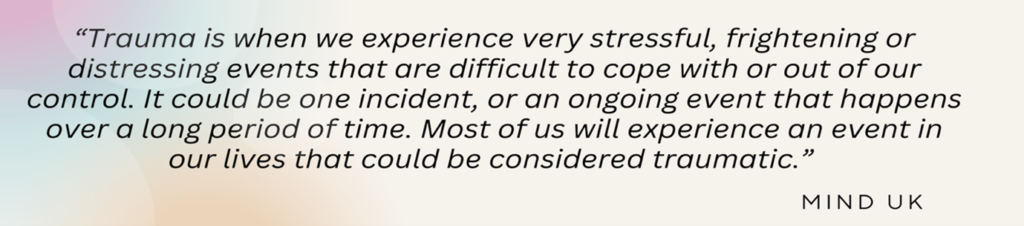
An adverse childhood experience, the breakdown of a relationship, death, accident, war, crime, generational trauma carried through families; trauma does not discriminate and what defines a traumatic experience for an individual varies. It would be naïve to think that we could guarantee psychological safety for all, but not considering a trauma-informed approach to communication could lead to significant problems.
- Insensitive communications can re-traumatise a person, a whole community, or employees. Triggering emotional responses and painful memories in individuals can lead to poor mental health and distress.
- Those who feel unsafe, unheard or misrepresented will disengage from services or work. For those already experiencing disadvantage, this exacerbates the problem.
- When working with people experiencing distress, using language that misrepresents or dismisses their feeling or situation can lead to anger, conflict and violence.
- Employees subjected to aggressive or poor behaviour can experience stress and become disengaged from work. Trust, empathy and a collaborative approach can reduce the risk of conflict in the workplace.
- By sending out insensitive communication, the recipient of the messages will disengage and lose trust, risking damage to relationships.
Trauma-informed principles (TIP)
Although an evolving approach, TIP is grounded in evidence originating with the SAMHSA (Substance Abuse and Mental Health Services Administration) who developed frameworks and principles that emphasise safety, trust, choice, collaboration, empowerment and cultural factors.

Guided by the six principles, a trauma-informed approach to communication draws upon fields that include social work, psychology and communication studies rather than relying on a single communication theory or model. By applying SAMHSA’s principles to our practice, we support organisations and communities to create environments built on trust, psychological safety, healing and collaboration, whilst making a conscious effort to resist re-traumatising service users and employees.
The CIPR (Chartered Institute of Public Relations) define PR as “the planned and sustained effort to establish and maintain goodwill and mutual understanding between an organisation and its publics”. The trauma-informed principles align perfectly by emphasising ethical practices that build trust, good reputation and consider wellbeing through effective communication.
Learning from the public sector
TIP is not just for the public sector and everyone can learn from the emerging evidence, a view shared by trauma-informed PR expert Kahshanna Evans in her podcast How To Transform PR With Trauma-Informed Practices.
It aims to reduce the long-term effects of trauma experiences and has been shown to improve engagement, support mental and physical health outcomes and compliance by creating environments which promote healing, feelings of safety and empowerment. The UK government has recognised how important TIP is, and acknowledges that trauma can have a significant impact on people’s thoughts, feelings and behaviours. An empathetic approach aims to prevent re-traumatisation by being sensitive to potential triggers and creating safe, supportive environments for individuals and communities.
A 2023 poll by mental health charity MIND UK “found nearly three in five people regularly hear harmful mental health language in the media and one in five people hear harmful language all the time” which led them to issue media guidelines. This is something that the British Red Cross has developed for the media when working with refugees and asylum seekers.
Traditional tactics
Historically, communication strategies often used emotional manipulation to influence behaviour and beliefs but now there is enough evidence to suggest that these are not beneficial to an individual’s wellbeing.
Fear tactics such as shock, sensationalism, violence and FOMO (fear of missing out) in the form of clickbait and rage bait online have been used to engage audiences. These controversial approaches cause distress and unwanted emotions such as fear, inadequacy, urgency and anxiety.
Arguably, these are unethical and inconsiderate to the audience, fostering anxiety and defensiveness, ultimately damaging brand loyalty, alienating service users and upsetting employees.
Some of the most iconic campaigns in modern history have used fearmongering to great effect. No-one around in the 1980’s can forget the AIDS: Don’t Die of Ignorance” campaign with John Hurt’s voice over iconic tombstone imagery. There is no doubt that this saved lives and raised awareness of HIV and AIDS, but the poster campaign ‘AIDS is not prejudiced—it can kill anyone’ instilled fear and stigma to those affected by the disease.
If this campaign were launched today, using a trauma-informed approach, it would look different. Reframing with this approach in mind today, we may communicate messages of hope and empowerment, focusing on prevention rather than certain death and giving a voice to marginalised groups. Respectful messaging would consider dignity rather than creating stigma with harmful stereotyping and judgement; survivors would be empowered to tell their story.
Just the latest communication ‘buzzword’?
Far from it! Popular classical and modern theories of rhetoric and persuasion align well with trauma-informed principles. Aristotle and Dr Robert Cialdini, both key contributors to the science and reasoning behind how we as practitioners work, founded theories based upon trust, emotional safety, compassion and credibility.
When Aristotle developed his theory of persuasion, Rhetoric, he based it on three core principles: ethos, logos and pathos and these apply these to trauma-informed communication in the present day. Credibility (ethos) builds trustworthiness. Emotion (pathos) requires empathetic language and safety. Logic (logos) empowers through evidence-based explanation.
Cialdini’s seven principles of persuasion (reciprocity, liking, social proof, authority, scarcity, commitment and consistency and unity) reinforce ethical, collaborative relationships, encourage mutual respect, foster trust, emotional safety, and promote inclusion. Cialdini’s social proof, shown in the ‘hotel towel experiment’ demonstrates peer behaviour influencing cooperation, although caution should be taken to consider if this adds pressure to conform or to follow the ‘wrong path’.