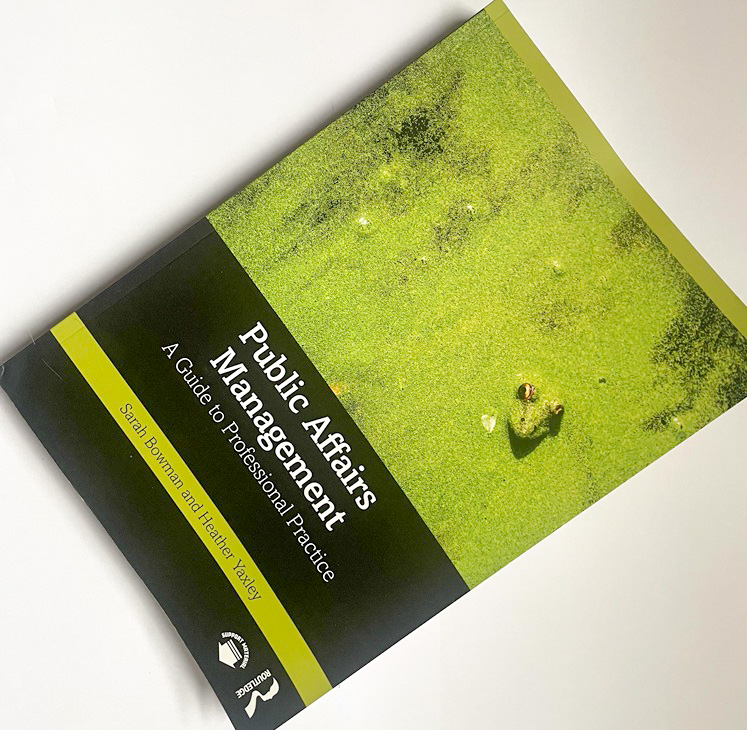
BOOK REVIEW: Public Affairs Management: A Guide to Professional Practice

About the author

Richard Bailey Hon FCIPR is an assessor with PR Academy. He has taught and assessed undergraduate, postgraduate and professional students.

Public Affairs Management: A Guide to Professional Practice
Sarah Bowman and Heather Yaxley
Routledge, 2026, 379 pages

Heather Yaxley reminds us that it was less than a century ago – in 1928 – that women finally gained equal voting rights to men in the UK.

That historical perspective, plus the current sense that democracy might not represent the ‘end of history’, makes this a well-timed review of the landscape of politics, public policy and public affairs.

What is public affairs?

We take a simple view: public affairs shapes decisions in the political arena.

Heather Yaxley

Lobbying is presented here as short-term and focused on messaging, whereas public affairs is longer-term, strategic and based around narratives.

I detect three books in this one volume: a textbook covering core concepts; an academic literature review, and a workbook of models and frameworks. This makes it difficult to read fluently, but makes it a valuable resource.

Students will discover foundational principles about systems of government and policy agendas. They will be able to explore the distinction between liberal democracy and illiberal democracy, between activist groups and advocacy groups, between campaigning groups and cause groups.

Practitioners will find tools for analysing, understanding and presenting their work and for furthering their professional development.

The most senior practitioners will be introduced to academic concepts in order to challenge their thinking. The table that shows the purpose of various approaches to research (eg analytical or applied, descriptive or diagnostic) will be as valuable to practitioners as to academic researchers.

This book explores concepts and principles and avoids country specifics, so differs from more traditional books on public affairs with their focus on how to schmooze in the corridors of Westminster.

The book’s strength is in turning concepts into actionable models. Take ‘policy analysis triangulation’ as an example. Viewing a policy situation from three different perspectives leads to a triangular model including a rational perspective (‘know-what’), a stakeholder perspective (‘know-who’) and a narrative perspective (‘know-why’). It’s analytical and it’s practical.
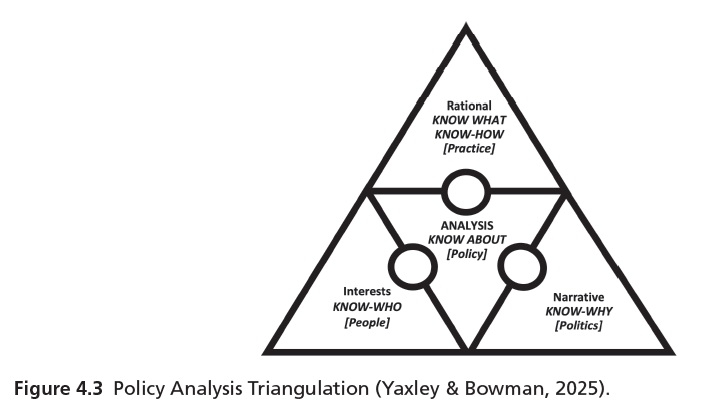
Image is a triangle divided into 4 sections as follows: Rational (practice), Narrative (politics), Analysis (policy) and interests (people). The authors call it Policy Analysis Triangulation

Sign up to our newsletter to hear about future book reviews

I could have chosen many other such examples: the book presents numerous mostly original figures and tables.

If the academic tone makes this a challenging read, this is balanced by the welcome inclusion of several sections (‘outtros’)  where the authors speak personally and in plain English about issues and questions arising from the previous section. So if the academic approach favours reason and deliberation, Bowman adds this much-needed rider: ‘The relationship between the rational and the emotional, the planned and the accidental seem too close to call to me.’

The book hints at the ‘quiet word’ as a way of influencing policymakers but rather than turning to the ethics and governance of lobbying the authors prefer to step back and talk about the principles of influence and persuasion.

There’s a useful focus on ‘nonmarket’ approaches in the section on strategic principles. Too often, problems are seen primarily through a commercial lens and relationships are viewed transactionally. Public affairs can be used in the pursuit of profit but it can equally be used to align an organisation’s interests with the public interest or to manage risk, issues and reputation.

Drawing on a concept from Shirley Harrison, the authors contrast the ‘loud’ marketing approach with the ‘quiet’ issues-management approach suitable for public affairs and the ‘moderate’ approach in public relations, focused as it often is on reputation.

Marketers shout; public relations people talk, while public affairs practitioners whisper.

This is a useful framework for understanding what happens when it comes to resource allocation within organisations. Fortunately, the social media age and cancel culture give plenty of examples of why organisations should often choose to tread softly in public. Should initiatives around diversity, equity and inclusion (DEI) be shouted about, talked about, or merely whispered?

There are two traditional ways of viewing public affairs. It can either be viewed narrowly as a specialism within (corporate) public relations. Or it can be viewed as a much broader discipline that embraces public relations and communication. Bowman and Yaxley have certainly gone big and broad here, and an upside of this is that despite its title this book is not solely for public affairs managers.

Senior public relations and corporate communication specialists will find value in the sections on strategy, planning, situation analysis and career development. As Bowman writes: ‘Public affairs sits at the interface between value and values and this is essential for organisational purpose and survival.’

Take the section on planning. Here the authors’ focus on ‘metamodernism’ (which may initially be offputting to practitioners) makes perfect sense. A ‘modernist’ approach to planning, developed in the last century, uses models that are rational and linear and imply that outcomes will be certain. These are the models that are still widely taught to students. The real world is not as predictable as these plans would suggest. There is no certainty that our inputs and outputs will lead to the intended outcomes. These linear models encourage us to focus on those things we can control rather than on the desired change we want to effect in others.

Besides, ‘public affairs practice is more dialogic, communicative, and when operating at higher levels of maturity it is co-creational, especially when solving policy problems.’

As a result, more recent approaches have adopted postmodern – or agile – approaches and value nimbleness and improvisation.

‘A rhizomatic plan is shaped by expansive learning. It requires constant updating, drawing new maps (cartography) and pathways to achieve organisational and policy impact that may itself be transforming. Different futures can be envisaged as stakeholders (including communities) take possession of different possibilities when coalitions and alliances shift.’

Ethics and professionalism is addressed in the last section of the book.

Professional public relations practitioners matter because democracy matters.

The focus here is on a broader discussion of ethics and professional development rather than a narrower country-specific discussion of codes of conduct and lobbying registers (though these issues are not overlooked).

The authors focus on the key question that had preoccupied Kevin Moloney, author of Rethinking Public Relations: whether public affairs supports or distorts the practice of democratic government.

In summary, Heather Yaxley is right when she writes: ‘This book contains a constellation of ideas, insights, frameworks, models, tools, techniques and much, much more.’

The authors view their approach as ‘bricolage’. I suggest ‘brocante’: browsing this book is like wandering through an antiques market in a small French town. You’ll walk past plenty of tired old junk but will be sure to discover something beautiful and valuable – and will wonder why others hadn’t already snapped it up.

Here’s an example of the beauty of simplification (arising from a discussion of professionalism). Competence is based on the past (what you have done); competency on the present (what you are currently doing); and capability refers to the future (what you can do). That may be an established framework, but is it widely known? It’s surely useful knowledge for everyone being appraised or considering applying for work, which must be almost everyone in public affairs.

This book is not for everyone, but there are rich rewards here for the curious reader.


Heather and Sarah have both worked with PR Academy over the years.