Amplify employee voice online without losing control
About the author
Ben Corbert is a Communications Professional with Skipton International Bank. He prepared this article for a CIPR Professional Diploma assignment while studying with PR Academy.
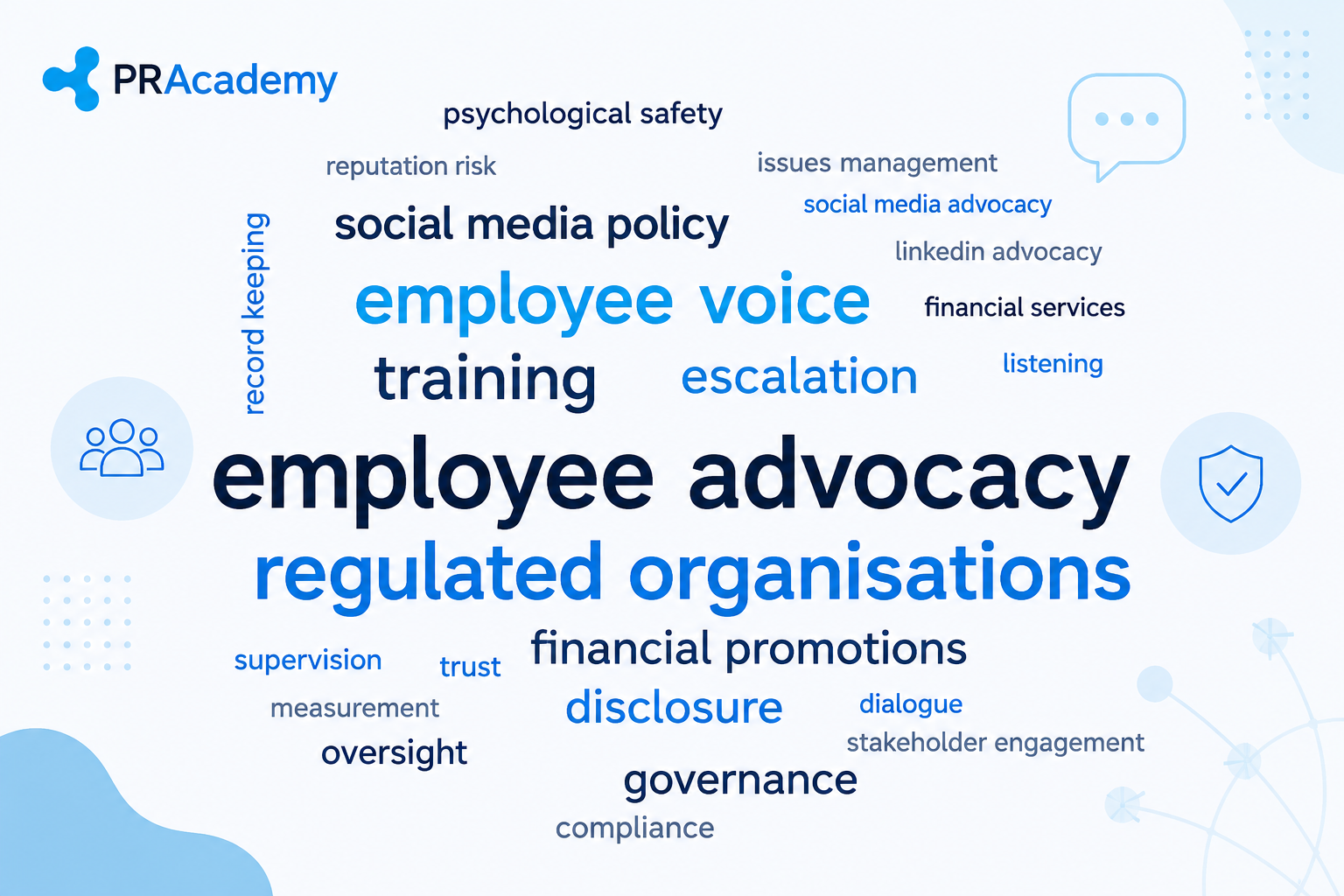
I understand why regulated organisations are often wary of employee advocacy. Public communications can create genuine issues around disclosure, misleading claims, confidentiality, and reputation. With that in mind, encouraging employees to post about their work can look less like an opportunity and more like an unnecessary risk.
Whether employers like it or not, employees regularly use platforms such as LinkedIn to talk about their jobs, their industry, and their expertise. Some do it well. Others do not. Few write with clear guidance from their employer.
I have worked in regulated organisations where use of social media is highly discouraged. A policy usually exists warning staff about the risks of posting about work. Managers then often reinforce that message more directly, advising staff never to post because it’s not worth it. But I don’t think this is a useful strategy. It sacrifices the potential value of employee advocacy and ignores the fact that many employees will use social media to talk about their profession and expertise anyway, whether the company supports them or not. I would argue, therefore, that the greater risk is not employee advocacy itself. It is a failure to govern employee voice at all.
Why this matters more in regulated organisations
I think regulated organisations make a mistake when they see social media as a softer means of communication that does not require governance. The FCA does not. Its guidance on financial promotions on social media is clear. The rules are technologically neutral, so the same standards apply across all advertising channels, including social media. That means employee advocacy cannot be treated only as a brand awareness tactic. The FCA’s most recent financial promotions data, covering actions taken against authorised firms, referrals, and investigations, shows that it reviewed 411 social media promotions across 21 firms in the year it issued that guidance. I would take that as a warning. The regulator is clearly not treating social media as a softer form of communication, and neither should senior managers.
Silence and overreaction both create problems
I don’t think this issue is solved by keeping employee advocacy at arm’s length or by completely restricting employees from posting about work. In some organisations, the response to risk is to write social media policies so broadly that employers are left uncertain as to what they can legitimately say online.
There are other costs to this approach. Employees’ work-related posts can shape how external audiences view an organisation. That is a powerful tool for anyone working in public relations.
Acta Psychologica Science Direct Article
That sense of connection is closely linked to psychological safety in the workplace, and it is employees who feel psychologically safe who are most likely to speak positively about the organisation.
Where I think many organisations go wrong is in framing employee advocacy as a nice-to-have communications choice. I would argue that, in regulated organisations, employee voice is part of the risk environment and this should be reflected in how it is governed.
The strongest objection is that employee advocacy can be too risky and resource-heavy to manage properly. Rules about financial promotions, disclosure risk, record-keeping requirements, and supervisory burden are real constraints. For many organisations, the issue is whether they have the time, systems, and resources to oversee the advocacy programme properly.
I think that is a serious objection, but it shouldn’t automatically lead to abandoning employee advocacy altogether. Those constraints do not make advocacy impossible, but they do make a casual approach impossible.
A simple framework for safer employee advocacy
So how do you encourage employees to advocate for the company online in a safe supported environment? One study shows that employees are more likely to communicate about work when organisations give them training, role clarity, and support and, having run an advocacy programme for a regulated bank for the past two years, here is the framework I use:
#1 Opt-in employees
Firms should avoid the temptation to turn advocacy into an expectation. Use an opt-in approach and communicate it clearly to staff.
#2 Training
Run short training sessions to employees who opt in. Provide practical guidance on risk points, disclosure, regulated claims, confidentiality, and what to do if they are unsure or if a post falls into a grey area. Record the sessions for later distribution or host them on an internal training portal.
#3 Content guidance
When highlighting company posts that you would like your advocates to interact with, give employees usable guidance. Show them what is in scope and what is out of scope by providing examples of posts or comments they could use. Do not assume each department understands what the others do. You may need to explain acronyms and provide additional context.
#4 Escalation route
Colleagues should know exactly who to go to if they are unsure about a post. If the escalation process is unclear or slow, they will either stop posting or post without asking.
#5 Approval only where required
Do not build a model around having to sign off every post. That becomes slow and far too resource heavy. Instead, define the types of posts that need review, for example any post that mentions a rate-led product.
#6 Post-publication monitoring
Keep an eye on what is being published, how it is landing, and on any emerging risks. If you have a social media monitoring platform, make sure it is set up to track mentions of your company.
#7 Record-keeping and review
Keep records of the guidance and training provided, and to whom. Review both regularly against the latest FCA rules. If the same questions or issues keep appearing, the guidance probably needs work.
Using this framework has helped us support employees to take part with confidence, making sure that they understand company policy and the boundaries around posting about work. It has also enabled us to have a demonstrable audit trail of training and guidance provided, should the regulator require this.
What good looks like
Employees are not expected to post constantly and are given suggested lines to develop, not completed posts or comments to copy and paste. Instead, they are given enough training, guidance, and confidence to talk about their work in a way that is useful, accurate, and authentic.
Good practice also means making the process easy to use. Colleagues should find it easy to locate guidance and escalate any grey areas. The system should not rely only on restrictions. It should actively help employees add value to public conversations, while staying within the social media policy.
A good advocacy programme looks controlled, voluntary, and well supported. It starts with a small group of employees who have opted in, understand the social media policy, know the boundaries, and know where to go if they are unsure about anything.
A good programme also does not confuse support with control. It does not need to pre-approve every post or turn employees into a second corporate channel. It gives room for employees to use their own voice, which research suggests adds credibility, while recognising that some topics need a higher level of oversight than others.
The clearest sign is participation. Employees take part in the programme because they want to, not because they have been pushed into it. Escalations happen early, rather than after something goes wrong, and guidance improves over time because teams learn from what people are posting and asking about.
A choice
The upside is that this framework gives firms a more controlled way to benefit from employee advocacy without leaving employee voice unmanaged. The result is not zero risk, but better-managed risk, which is often what regulators expect.
For me, this comes down to a leadership choice: Regulated organisations can continue to treat employee advocacy as an issue to avoid or restrict, or they can accept that employee voice is already part of the communications and risk environment and decide to govern it properly.

__________________________________________________________________
Ben Corbert’s perspective on studying for the CIPR Professional PR Diploma
Ben prepared this article for a CIPR Professional Diploma assignment while studying with PR Academy.
What do you see as the key benefits of studying the CIPR Professional PR Diploma?
The PR Diploma provides a valuable opportunity to build a deeper understanding of the strategic role that communications can play within an organisation. It has helped me strengthen my skills in research, planning and evaluation, while encouraging me to look beyond day-to-day activity and consider how communications can support wider organisational objectives.
The qualification also demonstrates a commitment to continuous professional development and provides practical frameworks that I can draw on throughout my career.
What has been your favourite part of the course so far?
My favourite part has been the opportunity to explore topics in greater depth and apply academic thinking to real communications challenges. The thought leadership unit was particularly rewarding because it encouraged me to develop and articulate my own perspective on an issue that is relevant to the profession.
I have also valued learning alongside other communications professionals. Hearing different experiences and perspectives has prompted me to challenge my own thinking and consider alternative approaches.
Have you been able to apply any of the learning, and if so, how?
Yes, the course has already influenced how I approach my work. I am more deliberate about connecting communications activity to clear organisational objectives, considering the needs and perspectives of different stakeholders, and thinking about evaluation from the outset rather than at the end of a project.
The course has also strengthened my confidence when contributing to strategic discussions. I have been able to use its frameworks and research-led approach to question assumptions, develop clearer recommendations and explain the rationale behind communications decisions.
About the CIPR Professional PR Diploma
The PR Diploma is a Master’s level qualification for more experienced practitioners who are looking to underpin what they do with theory and contemporary models. Topics include PR strategy and planning, content management, media and engagement, measurement and evaluation, and PR leadership and process improvement.
You have two years to complete it but with PR Academy you set your own study pace and many students finish in about ten months.